
Notion vs Monday in 2026: Simple CRM Options for Managing Leads
Notion vs Monday for lead management. Monday CRM has no free plan and a 3-seat minimum; Notion is $0 but you build it. Verified 2026 pricing.
Almost every Notion vs Monday comparison you'll read has the same flaw: it compares Notion against the wrong Monday product.
Search Monday vs Notion and you'll find dozens of feature tables. Nearly all of them benchmark Notion against Work Management, the general boards tool with the free plan, because Monday sells three separate things with three separate price lists. The one you'd actually run leads in is Monday CRM, which is a different product, costs different money, and has no free tier whatsoever.
So this guide compares the products you'd really choose between, with pricing pulled off both vendors' pages this month, and it says plainly where Monday is the better buy.
What Notion vs Monday Actually Compares
The confusion starts with Monday's product line. There's Monday Work Management (boards, tasks, projects), Monday CRM (contacts, deals, pipeline), and Monday dev and service beyond that. Each has its own pricing page.
Notion has no such split. It's one product: a workspace of pages and databases you shape into whatever you need, whether that's a wiki, a project tracker, or a CRM.
So the honest matchup for lead management is a purpose-built sales CRM against a flexible database you assemble yourself. That framing matters more than any feature table, because it predicts every difference that follows: what you pay, how long setup takes, what happens when you need a forecast, and what happens when your process is weird.
What Monday CRM Is
Monday CRM is a dedicated sales product, and it does not describe itself modestly.

*Monday CRM's homepage, monday.com/crm (July 2026).*
The pitch is an "AI-First CRM" and an "AI Revenue Execution Platform," with named agents doing lead sourcing, outbound calling, and meeting prep. Underneath the AI framing sit the things a CRM normally has: contact and deal objects, a pipeline with stages, quotes and invoices, email sequences, and reporting dashboards. Monday says 35,000-plus customers use it.
That is a different category of software than a database. Whether you need that category is the actual question this article is about.
What Notion Is as a CRM
Notion doesn't ship a CRM. It ships the parts.

*Notion's homepage, notion.com (July 2026).*
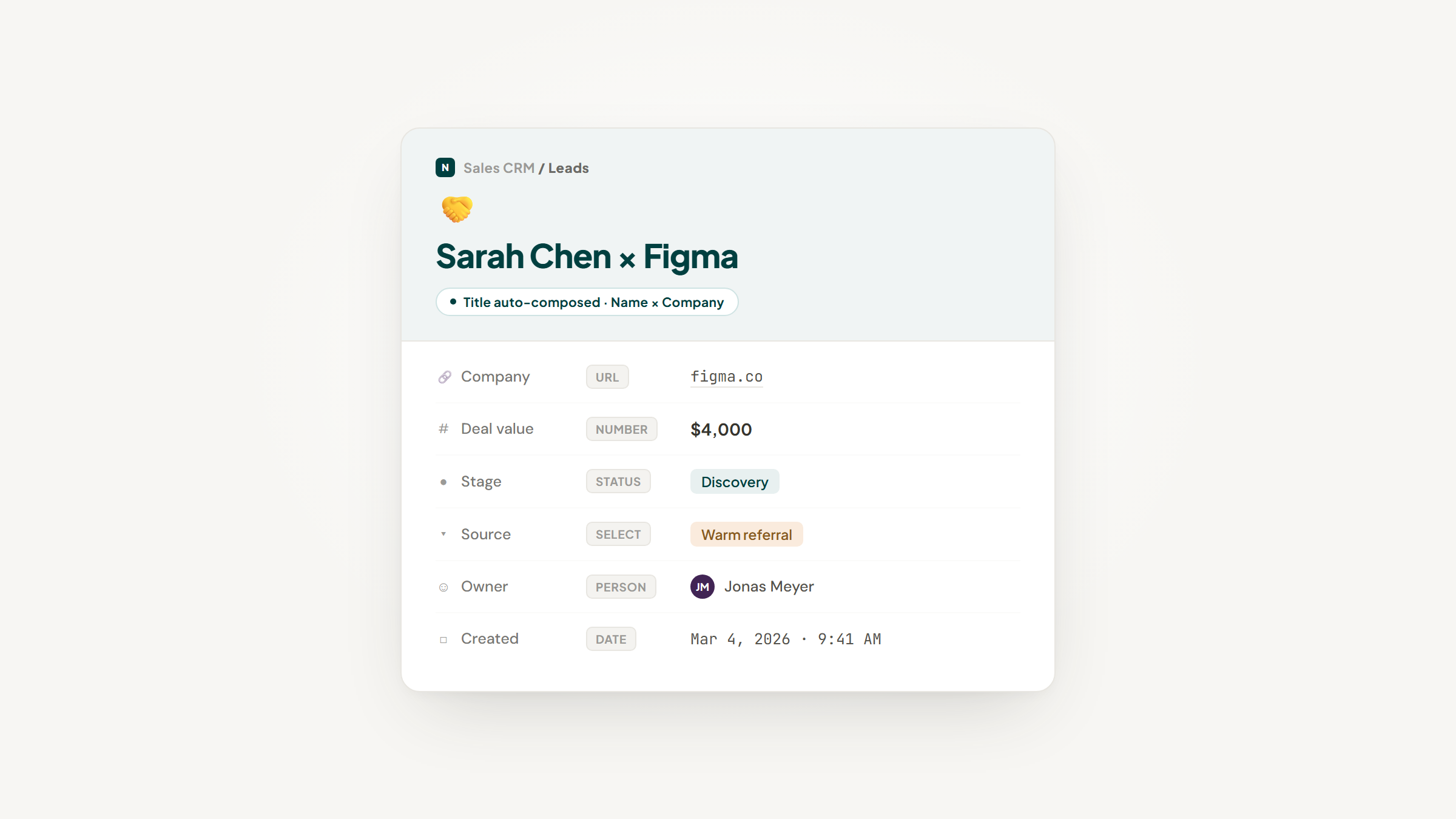
A Notion CRM is a database you make: a table where each row is a lead, with properties for company, deal value, stage, and last contact, and a page body underneath each row for notes. Relations connect it to other databases, so a lead can link to the project it becomes.
The sharpest description of this we've seen came from someone shopping for exactly this on Reddit, where the top reply cut through the marketing in one line: Notion is not a CRM, it's a database that can be used as a CRM. That's anecdotal, and it's also the most accurate sentence in this article. Everything Notion does well and badly as a CRM follows from it.
Notion vs Monday Pricing: The Free Tier Is a Mirage
Here's where most comparisons mislead you, and it isn't subtle. Monday's famous free plan covers Work Management, not the CRM.

*Notion's pricing page, notion.com/pricing (July 2026).*

*Monday CRM's pricing page, monday.com/crm/pricing (July 2026). Note there is no free tier.*
Monday's own FAQ says it plainly: the free plan is a plan of Monday Work Management, and what you get on the CRM is a 14-day trial of Pro. After that you pay. Here's the Notion vs Monday pricing picture for lead management specifically, taken from both pricing pages in July 2026.
Notion | Monday CRM | |
|---|---|---|
Free tier | Yes, $0, unlimited pages | None. 14-day Pro trial only |
Entry paid | Plus $10/seat/mo | Basic $12/seat/mo |
Mid | Business $20/seat/mo | Standard $17/seat/mo |
Upper | Enterprise, custom | Pro $28/seat/mo, Ultimate custom |
Seat minimum | None | 3 seats |
Cheapest real setup | $0 | $36/mo |
Contact limits | None | 1,000 / 10,000 / 100,000 by tier |
Those are annual-billing rates. Monthly costs more on both sides: Notion Plus is $12 and Business $24, while Monday CRM Basic is $18, Standard $25, and Pro $41.
Two traps worth naming. Monday's pricing widget defaults to a 10-seat team, so the large totals on screen are ten-seat totals, not per-seat prices. And Monday CRM's Basic tier caps you at 1,000 active contacts and deals, one dashboard, and 20 quotes a month, which is thinner than the price suggests.
Where Monday Genuinely Wins
For a lot of sales teams, Monday is simply the correct purchase, and four gaps drive that.
Reporting is the big one. Notion has no native pipeline dashboard. You can build charts, but there's nothing resembling a forecast view, and this complaint recurs in nearly every comparison and both Reddit threads we read. If your week involves showing someone weighted pipeline by stage, Monday does that on install and Notion does not.
Automation is the second. Monday CRM ships 250 automation actions a month on Standard and 25,000 on Pro, and they run against a sales object model that already exists. Notion's automations are real but thinner, and they can't reach outside Notion at all.
That object model is the third gap, and it's structural. Contacts, deals, quotes, invoices, email sequences, mass sending: Notion has none of this natively. You'd rebuild fragments of it and still not have sequences.
Compliance is the fourth, and it's the one that ends arguments. Monday carries HIPAA on its Ultimate tier plus a longer certification list (ISO 27001/17/18/32, SOC 1/2/3, CSA), where Notion's is shorter: ISO 27001, SOC 2, GDPR, CCPA. If you handle regulated data, that difference isn't a nice-to-have, it's the whole decision.
The review site Efficient rates Monday's CRM "highly customizable, for complex projects and large teams" and calls Notion's CRM "not good for businesses, basic and barebones." That's harsh on Notion, but it's a fair reading of the out-of-the-box experience.
Where Notion Genuinely Wins
Notion's advantages are real, and they're mostly not the ones vendors list.
The first is that your leads sit next to everything else. The proposal, the meeting notes, the onboarding checklist, the internal wiki: same workspace, linked by relations. In Monday, the CRM is a product you visit. In Notion, the lead record and the work product live in the same place, which for consultancies and small agencies is the entire point.
The second is arithmetic. One person can run a Notion CRM for $0 forever with unlimited records, where Monday's floor is three seats and 1,000 contacts.
The third is that it bends. If your process is unusual, Notion doesn't fight you, and every source we read agrees on this.
The fourth is that notes are first class. A Notion lead's page body is a real document, where in most CRMs notes are a text field bolted to a record.
The trade is honest and simple: Notion gives you flexibility and charges you setup time instead of money.
What Operators Say on Reddit
The monday.com vs Notion threads on Reddit are more balanced than either vendor's blog, and the most useful comment we found came from a self-described Notion expert arguing against his own tool.
Writing in r/Notion, he conceded that Notion can do more, especially with an automation tool bolted on, but that Monday does more out of the box without needing to learn as much, and has more automation built in than native Notion. His conclusion: as a Notion guru he'd choose Notion every time, but Monday is simply the better tool for a simple team that lacks a Notion advocate.
That last clause is the real test, and it's anecdotal but it matches everything else we found. Notion rewards teams with a builder in them. If nobody on your team wants to own the system, Notion decays into an abandoned database and Monday keeps working.
The Setup Cost Nobody Prices
Both tools cost more than their price tags, in different currencies.
Notion charges you in build time. Nobody hands you a pipeline; you design the properties, decide the stages, and wire the relations. That's an afternoon if you know what you want and two lost weeks if you don't.
Monday charges you in configuration and, at scale, in money. Efficient reports teams spending over $20,000 on Monday implementation, and flags the AI credit overage model as a bad deal at roughly $2,400 a year once you exceed what's included. Monday arrives as a structured blank slate too: the objects exist, but the pipeline, fields, and automations are still yours to build.
Neither tool is turnkey. The difference is that Monday's blank slate comes with a sales object model already in it, and Notion's comes with nothing but the ability to make anything.
Getting Leads Into Notion Without the Copy-Paste
If you land on Notion, you'll hit its real weakness within a week, and it isn't reporting. It's data entry.
Notion has no capture layer. Nothing in it can see the page you're reading, so every lead arrives by opening a tab, copying a name, pasting, copying a website, pasting, and repeating.
That cost is measurable rather than theoretical. The American Psychological Association, summarizing cognitive psychologist David Meyer's research, puts the cost of switching between tasks at up to 40% of someone's productive time. Every paste is a switch.
That's the gap we built Lead to Notion for. It's a free Chrome extension: you open a side panel next to the page you're on, type a name and a website, and the card title composes itself as Name x Company. It warns you before you save a duplicate, date-stamps every note, and shows deal value by stage with a weighted forecast. Most leads take about ten seconds.
It's free forever with no account, your Notion token stays on your device, and it's open source. Two honest caveats: it isn't in the Chrome Web Store yet, so installing means downloading a ZIP and loading it unpacked via Developer mode, and it needs a few required fields set up first. The setup guide walks through both.
None of that turns Notion into Monday. It removes the copy-pasting, which is a smaller claim and a true one.
Which One Fits Your Team
Verdicts, by the situation you're actually in.
If you… | Pick | Why |
|---|---|---|
Need pipeline reporting for someone else | Monday CRM | Notion has no native forecast view. This is disqualifying |
Handle regulated or health data | Monday CRM | HIPAA on Ultimate; Notion doesn't offer it |
Send sequences or mass email | Monday CRM | Notion has nothing comparable |
Have no builder on the team | Monday CRM | Notion decays without an owner |
Run leads solo or as a pair | Notion | $0 vs a 3-seat, $36/mo floor |
Want leads beside notes and docs | Notion | One workspace, real relations |
Have a genuinely odd process | Notion | It bends; a CRM object model doesn't |
Are already living in Notion all day | Notion | The switching cost is the hidden price |
The pattern is clearer than the vendors would like. Monday wins on everything a sales manager needs to see, and Notion wins on everything an operator needs to do.
Questions to Answer Before You Pick
Answer these honestly and the choice usually makes itself.
- Does anyone other than you need a report out of this? If yes, lean Monday.
- Who owns the system when it breaks, and do they enjoy building? No name here means Monday.
- How many people genuinely need a seat, remembering Monday's floor is three.
- Do your leads need to sit next to documents, or just next to other leads?
- Is your process normal enough that a standard pipeline fits it?
- Will you actually send sequences, or do you just like that the feature exists?
Question six catches more teams than the rest combined. Paying for a sales engine you never start is the most common way to overbuy here.
Making the Call
Businesses reach for tools like these for a reason the census data backs up: in the US Census Bureau's 2023 Annual Business Survey, 58.9% of businesses called specialized software very important to their processes, and the top reason they adopted it was improving the quality and reliability of those processes, cited by 49.8%. Reliability is the goal, not features.
So pick for the failure you can least afford. If that failure is "we couldn't produce a forecast," buy Monday CRM and stop reading. If it's "we spent $36 a month and 40 hours configuring a sales engine for a list of 60 leads," build it in Notion.
Already on Notion? Download our extension and the leads land without the copy-paste.
If Monday wasn't the rival you expected, Notion vs ClickUp runs the same numbers against a tool that does have a free tier worth using. And once your database exists, Notion automations covers what it can do for you unattended. The rest of our blog works through the same territory.
Frequently asked questions
No. This is the most common mistake in the Notion vs Monday comparison. Monday's free-forever plan belongs to Monday Work Management, its general boards product. Monday CRM offers a 14-day trial of the Pro plan, and after that the cheapest tier is Basic at $12 per seat per month billed annually. With the three-seat minimum, that's a $36 monthly floor. Notion's free plan has no seat minimum and no record cap.
Turn Notion into your CRM
Lead to Notion is a free Chrome extension. Save leads to your Notion database in one click, add notes, and track your pipeline. No account, no server.